
What is a foam surfboard?
A foam surfboard — also called a soft top, softboard or foamie — has a foam core covered by a soft foam deck and usually a slick plastic bottom. Our boards use an EPS core with stringers, a Water Barrier Skin deck and an HDPE bottom. There's no hard resin shell, so the board is soft to touch and to fall on.
What is a fiberglass surfboard?
A traditional surfboard is a shaped foam blank — polyurethane or EPS — laminated with fiberglass cloth and polyester or epoxy resin. The hard shell lets shapers make thinner rails, more refined shapes and lighter boards, which turn sharper and respond faster. It also makes the board easier to ding and harder on your body.
Side by side
| Foam / soft top | Fiberglass / epoxy | |
|---|---|---|
| Stability | Very high — wide and thick | Lower — narrower, thinner |
| Catching waves | Easy, lots of volume | Takes more skill |
| Performance in steep waves | Limited control | Sharp turns, more control |
| Safety | Soft deck and rails | Hard rails and fins |
| Durability | Shrugs off knocks | Dings and needs repair |
| Wax | Not needed on the deck | Needed |
| Price | Usually lower | Usually higher |
Who should choose a foam board
Beginners, kids, families and anyone surfing small, crowded beach breaks. The extra volume makes it much easier to catch waves and stand, and the soft construction keeps the lineup safer for everyone. Many experienced surfers keep a foamie for small days because it's simply fun.
Who should choose fiberglass
Intermediate and advanced surfers riding steeper, more powerful waves, who want a shortboard or a refined longboard that responds to every movement. If you surf a lot and want to progress your turns, a hard board — or a performance soft top like Storm Blade — will reward you.
Do fins matter on a foamie?
Yes. A thruster setup of three 4.5" fins, like the one on our Classics, adds hold and lets you start turning. Larger single fins add stability for longboarding and paddleboarding. Keep a replacement fin set handy, because fins are the part most likely to go missing.
Do you wax a foam surfboard?
Usually not. The soft deck grips well and our boards have a traction pad. A light basecoat can help if you surf without a wetsuit and find yourself slipping. Fiberglass boards always need wax.
Care and repair
Foam boards hate heat: don't leave them in a hot car or in direct sun for long. Rinse off salt and sand, store them flat or in a board sock, and remove fins for travel. Small dents in a soft deck are cosmetic. Fiberglass boards need a repair kit for dings to keep water out of the blank.
Boards to look at next
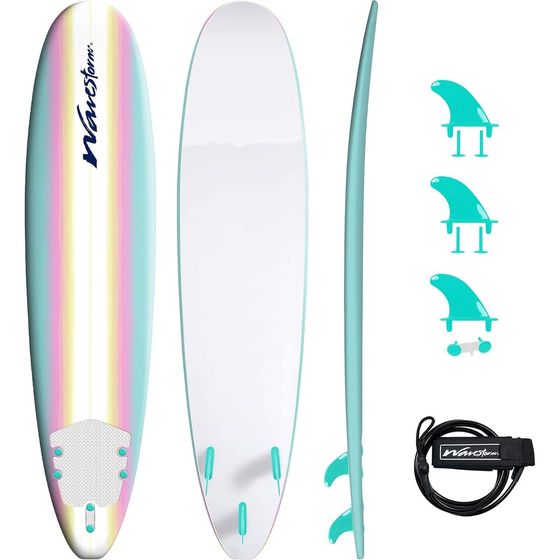 Wavestorm
 8ft Classic Soft Top Surfboard
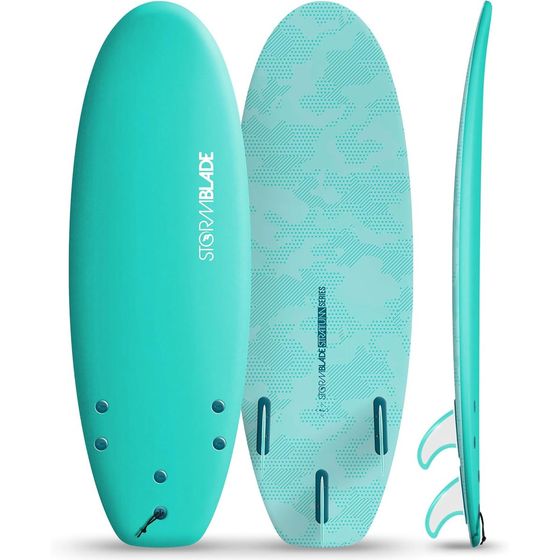 Storm Blade
 ASL Stratum Soft Surfboard